
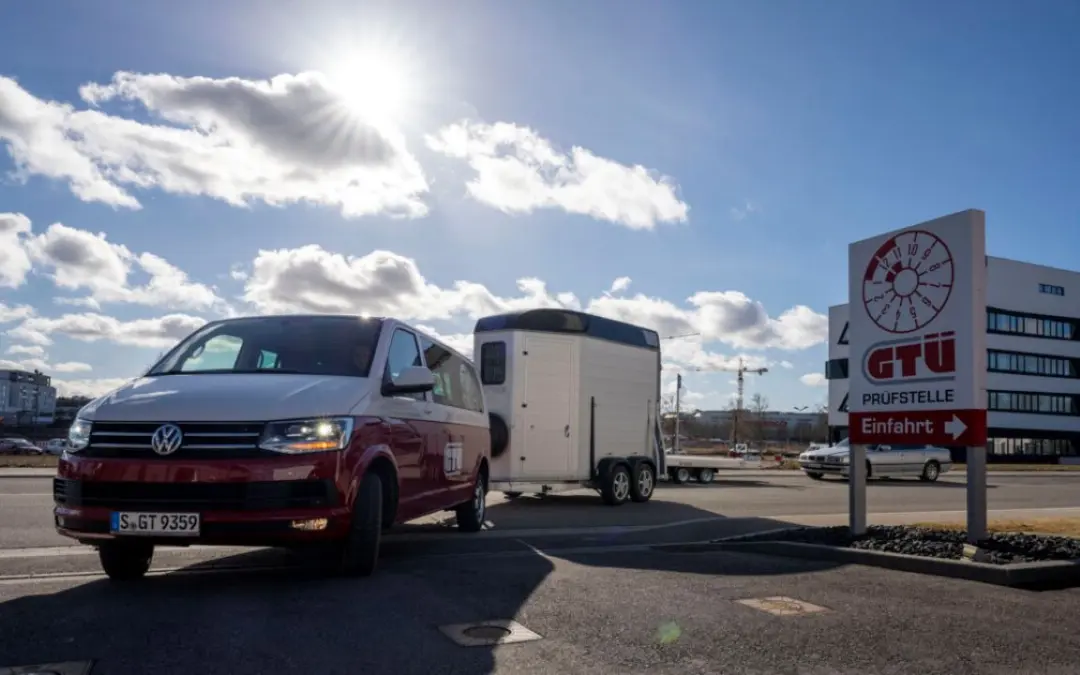
Towing a Trailer: Reaching Your Destination with Composure
• Special regulations and characteristics of the combination
• Practice makes perfect when reversing and maneuvering.
• Driver’s license requirements must be observed.
A trailer has been purchased? Perhaps even a large one—a caravan? This marks the beginning of a new chapter in driving. By coupling the trailer, the flexible passenger car becomes a far less maneuverable combination. This combination is subject to its own rules—both legally and practically. GTUE Gesellschaft für Technische Überwachung mbH provides several tips on what to observe.
The most important advice is: Approach the matter calmly. This begins with coupling. All steps must be carried out carefully: connecting the trailer hitch to the ball head on the car and closing the anti-sway coupling, if present. Always insert the electrical cable. Sometimes an adapter is necessary. Is the breakaway cable looped around the coupling? Finally, check everything once more. Only then is the connection reliable overall and the trailer cannot jump off the ball head—this has actually happened.
Safe coupling also includes the mandatory test of all rear lights on the trailer. In addition, the car’s tires must be inflated to the correct pressure for trailer operation. The relevant data is provided in the operating manual. Is the jockey wheel raised and locked in this position? Are the additional exterior mirrors mounted for oversized trailers? Have the wheel chocks been removed from the road? If all these questions can be answered with “Yes,” the journey can begin.
At this moment, the experienced driver mentally switches to a different mode: they are essentially controlling a completely different vehicle than usual. For the inexperienced, it helps to keep this in mind repeatedly. From this moment on, they acknowledge the combination’s characteristics. Anticipatory driving is even more important than usual. The combination is longer, wider, and higher than the solo car, especially with caravans. The noise environment is different. Wider turns must be taken in curves. It is absolutely necessary to keep an eye on oncoming traffic. When overtaking, more space is needed for pulling out and merging back in than usual. The blind spot requires particular attention. When accelerating, the combination responds more sluggishly to the accelerator. The braking distance is longer. Here too: When driving a combination, composure helps. Hasty actions are out of place.
Are you going on vacation with the caravan? Then you should definitely plan sufficient breaks. In addition, the average speed is significantly lower than with a solo car. Therefore, the family should expect a journey time 30 to 50 percent longer.
Route planning also requires care. Does the initially selected route include extreme inclines and declines or very narrow roads? Sometimes it is more pleasant to avoid such sections and accept a route that is a few kilometers longer. Navigation systems help increase safety. There are solutions, including mobile apps, that consider not only the lower driving speed but also the combination’s dimensions when calculating the estimated arrival time. They recommend only suitably appropriate routes.
Reversing and maneuvering are a real challenge for beginners with a trailer. The rear of the trailer moves in the opposite direction to the steering movement of the towing vehicle when reversing. A short practice session in an empty parking lot provides some routine. Modern vehicles have built-in maneuvering assistants that can be a great help. A spotter is indispensable, who also warns rearward traffic. Anyone who feels uncertain can take a few additional driving lessons. Alternatively, a special driver safety training course can be completed, as this usually includes maneuvering as well.
Regarding legal aspects: In Germany, combinations may travel at a maximum of 80 km/h outside built-up areas. This also applies to the motorway, unless the trailer has a 100 km/h approval. The slightly higher speed allows overtaking trucks. However, caution is advised at higher speeds, as the trailer can react sensitively to crosswinds. Different speed limits often apply abroad: It is best to inform yourself beforehand so that no fine burdens your travel budget.
On the road, attention must be paid to special traffic signs. For example, there is an overtaking ban for combinations, indicated by a symbolically depicted car with a trailer. Less common is the prohibition sign for long vehicles. It shows a truck and specifies the relevant length, which then also applies to combinations. Other signs warn of narrow passages or low clearance heights. Using a cheat sheet attached to the dashboard containing information on the combination’s length, width, height, and weight allows you to see at a glance whether passage through a bottleneck is possible.
Special regulations also apply to parking. Some examples: – If a registered trailer is parked at the roadside without a towing vehicle, it may remain in this location for a maximum of two weeks. If it is coupled to a towing vehicle, there is no time limit. However, it must be a parking space that is not designated exclusively for cars. A combination may not be parked there. Trailers weighing up to 2.8 tons may be parked on the edge of sidewalks if traffic signs permit this. The corresponding markings must not be exceeded. If the trailer is heavier, it must be parked in a truck parking area.
Finally, regarding the driver’s license. Those who acquired it before 1999 are in a good position. With the former Class 3, the driver may operate three-axle combinations with a total weight of 12 tons. It is different with Class B: With it, the trailer may weigh a maximum of 750 kilograms. Class B can be extended without an examination and usually through a one-day course with the B96 addition to tow heavier trailers. In both cases, with or without B96, the weight limit for the complete combination is 4.25 tons. Quick calculation: If the towing vehicle weighs 2.2 tons, for example, 2.05 tons remain for the caravan. Both apply to the fully loaded and ready-to-drive condition. This should be sufficient for many cases. Alternatively, the driver’s license can be extended to Class BE, then the total combination may weigh seven tons. A look at motorhomes: With a Class B driver’s license, it may weigh a maximum of 3.5 tons. For a weight of up to 7.5 tons, Class C1 is required. This driver’s license is valid for a limited period. After five years, a medical certificate of fitness and a current eye test must be submitted for renewal.
Author: Michael Teschke | Source and Photo: GTUE
Networking:

Share it:


