
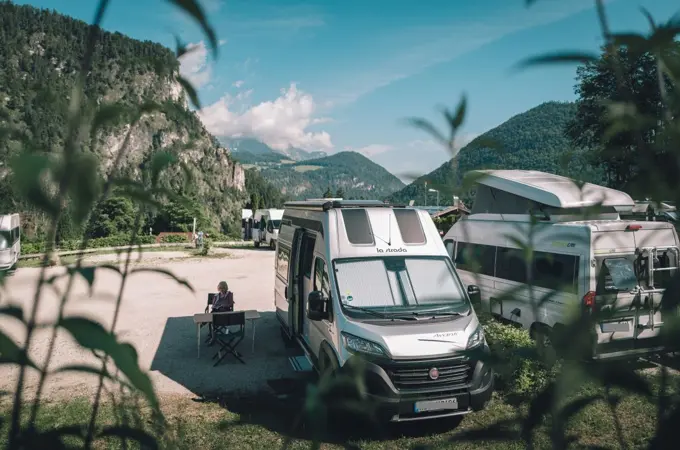
Buying a motorhome? What to consider:
+ Choose a vehicle that matches your driving licence category
+ The driving characteristics usually differ significantly from those of a passenger car.
+ Permissible gross vehicle weight, traffic rules and periodic technical inspection
Camping has been a major trend in recent years. One question often sparks debate: caravan or motorhome? Arguments in favour of a camping trailer include the lower purchase price and the fact that the towing vehicle can be used for excursions at the destination. The motorised camping vehicle, on the other hand, scores with better manoeuvrability and greater flexibility for overnight stays en route. The statistics clearly favour the motorhome: more than one million motorhomes currently registered in Germany exceed 780,000 caravans (as of 2025). Whether a minibus conversion, panel van, semi-integrated or fully integrated model: what should you consider when it comes to motorhomes? GTUE Gesellschaft für Technische Überwachung mbH provides an overview.
Driving licence
All of the vehicle types mentioned are open to anyone who holds the former Class 3 driving licence. This was issued until December 31, 1998. It allows you to drive any vehicle with a maximum gross vehicle weight of up to 7.5 tonnes. That already covers a lot. However, there are even larger motorhomes based on trucks or buses. These not only require a substantial budget to purchase, but also a truck driving licence. Anyone who obtained a Class B driving licence after January 1, 1999 may drive vehicles with a permissible gross vehicle weight of 3.5 tonnes. Good to know: the driving entitlement can be upgraded. With Class C1, vehicles up to 7.5 tonnes may be driven. This can be renewed every five years upon presentation of a health and eye examination.
Try it out and visit trade fairs
Some camping newcomers are quick to buy a vehicle. However, it is by no means a bad idea to rent the vehicle of choice, or a similar model, first. This allows you to try out living on four wheels and driving. After this real-world test, some people adjust their choice and perhaps opt for a larger motorhome if the space in a panel van does not quite meet expectations. Or the other way around, towards a smaller vehicle because it is simply more manoeuvrable. Visiting major camping trade fairs is also helpful.
Converted minibus
A converted minibus drives most like a passenger car and is also agile in the city or when looking for a parking space. The larger the vehicle, the more its characteristics change. For example, a large motorhome generally accelerates significantly more slowly than a passenger car, and the braking distance can be considerably longer. Relaxed, anticipatory driving is important—something motorhome pros already see as part of slowing down and as a plus for a holiday on four wheels.
Full-size motorhome
A full-size motorhome is not exactly nimble. You therefore always need to keep the overall dimensions in mind to avoid getting caught on the side in tight bends or on top in low underpasses. When pulling out, the often generous “blind spot” must be taken into account. When reversing, a second person to guide you is essential—and a reversing camera is also useful.
A driver safety training course is always a good idea. There you learn to control the vehicle better in tricky situations, such as evasive manoeuvres or emergency braking. Special navigation systems that take vehicle dimensions into account when planning routes are also useful. This helps avoid, for example, very narrow roads or low underpasses. Of course, this does not remove the obligation to still pay attention to the relevant traffic and information signs, as not all critical points are precisely recorded in digital road maps.
Loading and gross weight
When loading your holiday equipment, always keep an eye on the permitted gross vehicle weight. If, for example, the motorhome has an unladen weight of 2,900 kilograms with all fixtures and optional equipment and may weigh a maximum of 3,500 kilograms, then 600 kilograms are permitted. Since a motorhome cannot be driven without a driver, 75 kilograms are already included in the unladen weight. Every additional person counts as extra weight. If, for example, three people and a dog plus the family’s full travel luggage are added, 600 kilograms of payload is no longer quite so generous. If you exceed the permitted gross vehicle weight, fines are due, which in some countries can reach substantial amounts in the four-digit range. Before weighing each item individually when loading: ideally, drive the fully packed motorhome onto a vehicle scale. These are often available nearby, for example at building materials dealers or waste disposal companies.
Traffic rules
Which traffic rules apply to motorhome drivers? Here are a few examples: Up to a permissible gross vehicle weight of 3.5 tonnes, the same speed limits apply as for passenger cars. With a permissible gross vehicle weight of up to 7.5 tonnes, the maximum speed outside built-up areas and on expressways is 80 km/h, and 100 km/h on motorways. With a gross vehicle weight over 7.5 tonnes, the limits for trucks apply: 60 km/h outside built-up areas and 80 km/h on expressways and motorways. Some signs also apply to motorhomes: if trucks are subject to a through-traffic ban, an overtaking ban or a minimum distance requirement, this also applies to motorhomes over 3.5 tonnes. Less common are a through-traffic ban for trucks of a certain length, which is indicated on the traffic sign, or for vehicles with a higher axle load than indicated on the sign. These restrictions naturally also apply to motorhomes with these characteristics.
Periodic technical inspection (HU) – gas inspection
Motorhomes are, of course, also subject to the obligation to undergo regular periodic technical inspections (HU) in accordance with Section 29 of the German Road Traffic Licensing Regulations (StVZO), including an emissions test. GTUE test centres welcome camping enthusiasts—and it is not uncommon for a lively conversation to arise about the most recent holiday trip with the vehicle. A motorhome up to 3.5 tonnes is treated like a passenger car. If it is new, the first HU is due after three years. After that, it must undergo HU every two years. For motorhomes from 3.5 to 7.5 tonnes, the first periodic technical inspection is due no later than after two years. After that, the vehicle must also be presented for HU every two years. From the sixth year onwards, the inspection is due annually. Motorhomes with a permissible gross vehicle weight of more than 7.5 tonnes must always undergo the periodic technical inspection once a year.
Many motorhomes have gas-powered appliances on board, such as a cooker or heater. The gas system must be checked for leaks every two years. The gas inspection does not have to be carried out together with the periodic technical inspection, although this is often the easiest option. GTUE test centres are also equipped for this.
Author: Michael Teschke | Source and photo: GTUE (08-2023) | editorially revised 2026-04-27
Networking:

Share it:


